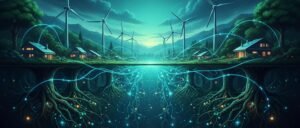
The Cost of Doing Less Harm
For decades, “sustainability” in energy meant simply reducing damage—fewer emissions, fewer leaks, less waste. The “But” is that in a degraded world, doing less harm is no longer enough. We are facing biodiversity collapse and ecosystem fatigue. An energy transition that only focuses on carbon while ignoring the living land it sits on will ultimately fail to secure its own social and ecological foundation.
We need to move from “Sustainable” (maintaining the status quo) to Regenerative (improving the system).
Therefore: Infrastructure as Ecosystem Support
AI transforms energy sites from industrial zones into active participants in ecosystem recovery. By monitoring biological data alongside energy production, we can design dual-use systems that generate power and life simultaneously.
- Agrivoltaics Optimization: AI models analyze shade patterns and soil moisture under solar panels to guide the planting of crops or pollinator habitats. [cite_start]This increases land-use efficiency by over 60% [cite: 1700] while cooling the panels, which actually improves energy generation efficiency.
- Wildlife-Responsive Operations: Smart cameras and acoustic sensors on wind farms detect approaching bird flocks or bat colonies. The AI automatically curtails turbine speed for the brief window of passage, preventing collisions without significant generation loss.
- Hydro-Biological Sync: AI manages hydroelectric dam releases to mimic natural river pulses, supporting fish migration and sediment flow while optimizing power generation for peak price windows.
Commercial Impact: The Social License
Regenerative energy is not charity; it is a superior asset class:
- Permitting Speed: Projects that can prove environmental net-gain face far less community opposition and move through regulatory approvals faster.
- Land Value: Solar farms that improve soil health (through grazing or cover crops) leave the land more valuable at the end of the lease than at the start.
- Premium Power Purchase Agreements (PPAs): Corporate buyers with strict ESG mandates are willing to pay a premium for energy that comes with verified biodiversity credits attached.
We can build power plants that function like forests. AI gives us the blueprint.